
Whose Gold
The data behind live music's supposed golden era — and twenty-five years of firsthand evidence about who actually gets paid for it.

A few weeks ago, a Hollywood executive named James Crane posted a video to his followers announcing that live music is entering its golden era. $2.5 trillion. A global infrastructure boom. A phrase I actually like — extreme AI creating extreme analog, meaning the more synthetic our digital lives get, the harder we crave the real thing.
I want him to be right. I’ve built the last three years of my business on a version of that same bet, long before “anti-algorithm” became a topic of conversation. So I did what I do with every claim that lands in my feed with a big number attached: I went and checked the math.
It doesn’t hold up. Not the way he’s telling it.
The $2.5 trillion figure isn’t a live music number. It’s the entire global events industry — corporate seminars, trade shows, conferences, the whole category — and it’s a projection for 2035, not a measurement of today. Live music specifically, right now, is something closer to a $40 billion slice of that pie. Crane borrowed the whole cake to describe one slice of it. That’s not dishonesty, necessarily. It’s the kind of number that sounds better in a caption than the one that’s actually true, and it’s easy to reach for when you’re building a case for optimism rather than checking one.
It’s worth knowing where Crane is actually standing when he says it. He’s not a touring musician or a venue owner. He’s the director of business development at a Hollywood production studio that partners with brands to fund and produce premium content — before that, several years as a talent agent. That’s a real, credible vantage point. It’s also a vantage point that gets paid when big companies feel optimistic about spending money on experiences. None of that makes him wrong. It does make his optimism a data point about where the capital is flowing, not a measurement of what it’s like to be the person on the stage.
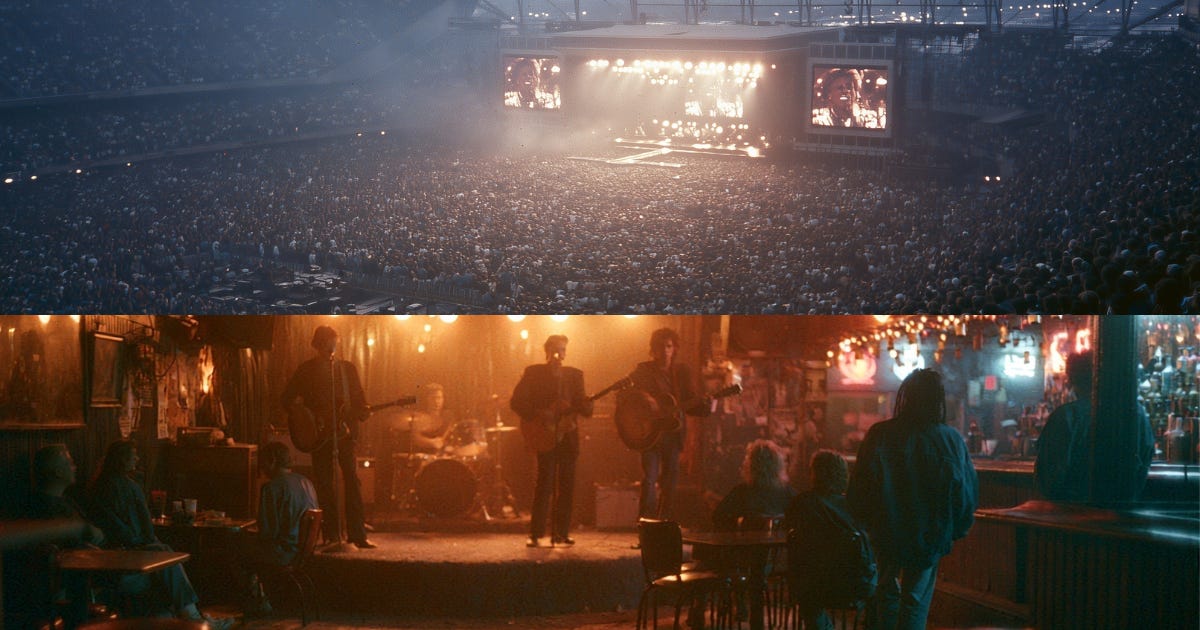
Here’s what’s actually happening in the rooms Crane isn’t counting. Three weeks before his post, Heritage Live canceled its entire 2026 UK festival season — Eric Clapton, Lionel Richie, Christina Aguilera, all of it — citing rising costs and a ticket-buying public that’s tapped out. This season alone, Post Malone, Meghan Trainor, Lily Allen and others pulled tour dates after sales came in soft. Working artists, with current charting music, unable to move enough tickets to justify the dates. The industry has a name for this now: Blue Dot Fever, after the unsold seats that show up blue on a promoter’s seating chart. I built a full episode around this a few months back and it ended up on national talk radio, reaching well over a hundred markets, back when it was still being treated as a fringe observation rather than a trend with a name. It isn’t fringe anymore. It’s the thing Crane’s own numbers are quietly built on top of.
Meanwhile the average concert ticket has gone from $82 in 2020 to $144 this year. That’s not inflation. That’s a business model deciding how much the audience can be made to absorb before they stop showing up — and Heritage Live is a data point suggesting we’re closer to that ceiling than the golden-era narrative wants to admit.
Pollstar’s own data tells the more granular version of the same story. Club shows under 750 capacity — the rooms where almost every working musician actually makes a living — have lost average attendance every year since 2023. The boom Crane’s describing is real. It’s just concentrated almost entirely in stadiums and arenas, while the tier underneath it keeps contracting.
And it isn’t only a touring problem. I’ve already reported on the streaming side of the same retreat: seven of the top ten most-streamed songs on Spotify on a single day this year were more than two years old. People aren’t just skipping the ticket. A meaningful share of them have stopped listening to anything new in the first place, streaming or otherwise. Whatever appetite exists for “extreme analog,” it isn’t currently translating into demand for new work — it’s translating into demand for the familiar, at scale, from acts who’ve already made it.
The best rebuttal to Crane’s post didn’t come from me. It came from his own comment section. One commenter — a decade running a record label, booking tours across four continents — made the case of what the industry really looks like from the indie perspective. They said the corporate side of live entertainment keeps growing because that’s where the investment is flowing, not because musicians are suddenly cashing in. Fewer viable venues for developing artists every year. More competition for a shrinking pool of disposable income. And once you subtract venue costs, ticketing fees, production, staffing, and marketing from the gross, what’s left over for the person who actually wrote the songs and stood on the stage rarely resembles anyone’s idea of a golden era. Crane’s own audience fact-checked him for free, and did it with more precision than most of the press coverage of this topic.
Here’s where I’ll put my own hands on it, because I think the credential matters more than the opinion. I’ve spent 25 years building a business specifically designed to stay underneath the part of the industry Crane’s numbers are describing — corporate bookings, seasonal shows, singing telegrams, rooms measured in dozens or a couple hundred, not thousands. That positioning isn’t an accident, and it isn’t nostalgia. It’s the direct result of watching, for a long time, what happens to the artists whose entire business model depends on stadium-tier economics holding steady, and building something that doesn’t share that dependency. The performance work funds everything else. The writing and reporting multiply what the performer can charge. Neither loop assumes I’ll ever need 50,000people in a building at once, because I’ve watched what happens to the people whose plans require it.
When I go out on a weeknight to watch original acts play rooms in this city, the turnout is modest more often than not — even here, in a city with more live music happening on any given night than most people could see in a month. That’s not proof the appetite for something real isn’t growing. It’s proof that appetite, wherever it’s landing right now, isn’t landing evenly, and it certainly isn’t landing on the guy playing to forty people on a Tuesday night.
None of this is unique to music. Any time you see a growth statistic used to describe an entire industry, it’s worth asking what altitude that growth is actually happening at. The events industry is genuinely booming — at the corporate and stadium tier. Streaming revenue is genuinely still growing — concentrated overwhelmingly at the top of the charts. AI probably is pushing people back toward rooms with other humans in them — and the infrastructure being built to capture that instinct is, again, mostly stadium-sized. The pattern isn’t specific to live music. It’s what happens whenever someone with a stake in the top of an industry describes the whole industry from where they’re standing, and calls the view universal.
I don’t think Crane is lying. I think he’s describing something true from a vantage point that doesn’t include most of the people who’ll read this. That’s a distinction worth holding onto the next time somebody hands you a trillion-dollar number and asks you to feel optimistic about it.
Golden era. Check whose gold it is.
Jay Bragg is a Nashville-based third-generation entertainment impresario, creator of New Vaudeville, and 25-year performing artist. View From Nashville publishes weekly at yougottabecrazy.substack.com — dispatches from inside the machine.